


Discover Solvents & their Key Applications
Solvents are essential functional materials in modern value chains
Solvents enable formulations, chemical reactions, and high-tech applications – from pharmaceuticals and electronics to paints, adhesives, and energy technologies. As a versatile group of substances, they fulfil different roles: reaction medium, extraction agent, processing aid, or building block for synthesis.
Across Europe, tens of thousands of companies rely on solvents. They are needed wherever precision, quality, and efficiency are critical.
Our website provides a solid overview of the chemistry, production, applications, and regulatory aspects of solvents – for experts who work with them or make decisions about them.
What Are Solvents?
A solvent is a liquid that can physically dissolve other substances without chemically altering itself or the dissolved material. “Solvent” is not a fixed category of substances but a role that a substance performs — whenever it dissolves something.
Therefore, in principle, any substance can act as a solvent if its properties are suitable.
Types of Solvents
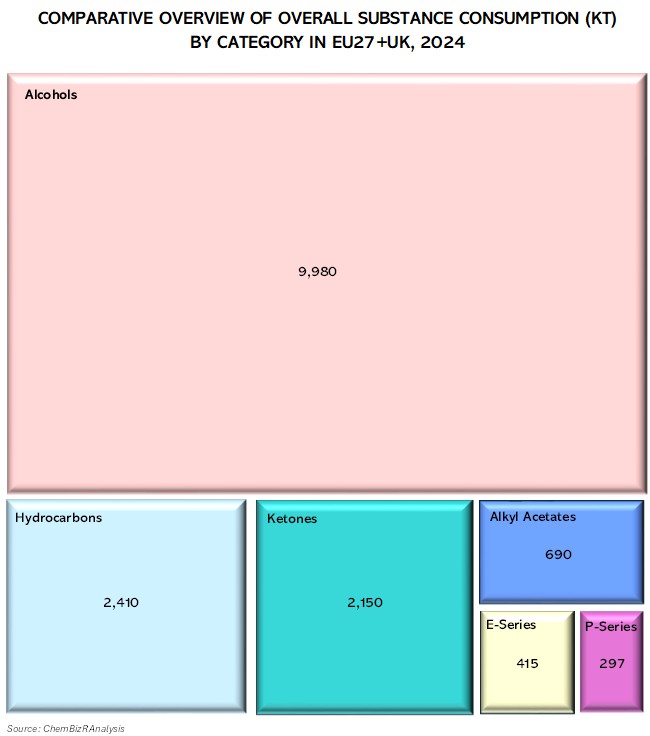
Solvents can be broadly divided into two main groups: organic and inorganic.
Organic solvents contain carbon and form the largest category. Within this group, oxygenated solvents such as alcohols, ketones, esters, and glycol ethers are known for their high solvency power and versatility. Hydrocarbon solvents—including paraffinic, aliphatic, and aromatic substances like toluene and xylene—offer excellent water separation properties and are essential in applications such as paints, cleaning agents, and various industrial processes. Halogenated solvents are used in situations where exceptionally strong cleaning performance is required.
Inorganic solvents, instead, play a smaller but key role, with water being the most widely used solvent worldwide.
How Are Solvents Produced?
Most solvents are produced through petrochemical processes that involve cracking, distillation, and a series of conversion steps. A typical starting material is naphtha, which is cracked into ethylene and propylene. These basic building blocks form the foundation for many oxygenated solvents such as alcohols, ketones, and esters. In addition, several hydrocarbon solvents are obtained directly through refinery distillation without further transformation.
Solvents can also be produced from bio based raw materials. Examples include ethanol derived from sugarcane through fermentation or bio naphtha that is processed into bio ethylene and bio propylene. Depending on the production route, bio based solvents may be chemically identical to their fossil based equivalents, or they may exhibit different structures and properties.
Properties of Good Solvents
Whether a substance can dissolve another effectively depends largely on how well its properties match those of the material to be dissolved. A simple rule of thumb helps illustrate this: “like dissolves like”—meaning substances with similar characteristics tend to dissolve each other particularly well.
A good solvent should also be easy to handle and evaporate quickly, so it can be removed effortlessly after use. In both everyday applications and technical processes, several key properties determine how well a solution performs.
Good solvents exhibit strong solvency, meaning they can dissolve materials without triggering chemical reactions—for example, water dissolving salt or hexane dissolving oil. Their polarity plays a crucial role: polar solvents such as ethanol dissolve other polar substances, while non polar solvents like toluene are effective for non polar materials. Another important feature is volatility; solvents that evaporate rapidly—like acetone—leave surfaces dry within moments.
Chemical stability is equally essential. A solvent should not react with the dissolved substance, such as when stabilizing dyes without altering them. Good solvents should also mix well with other liquids, as seen with alcohols blending easily with water. Finally, they should leave minimal residues, ensuring a clean finish—ethyl acetate in nail polish remover is a typical example.
Why Do We Actually Need Solvents?
Solvents are present everywhere—in industry, everyday life, and high‑tech applications. Many products simply would not work without them. In Europe alone, around 72,700 companies use solvents, ranging from paint manufacturers and pharmaceutical companies to agriculture and electronics.
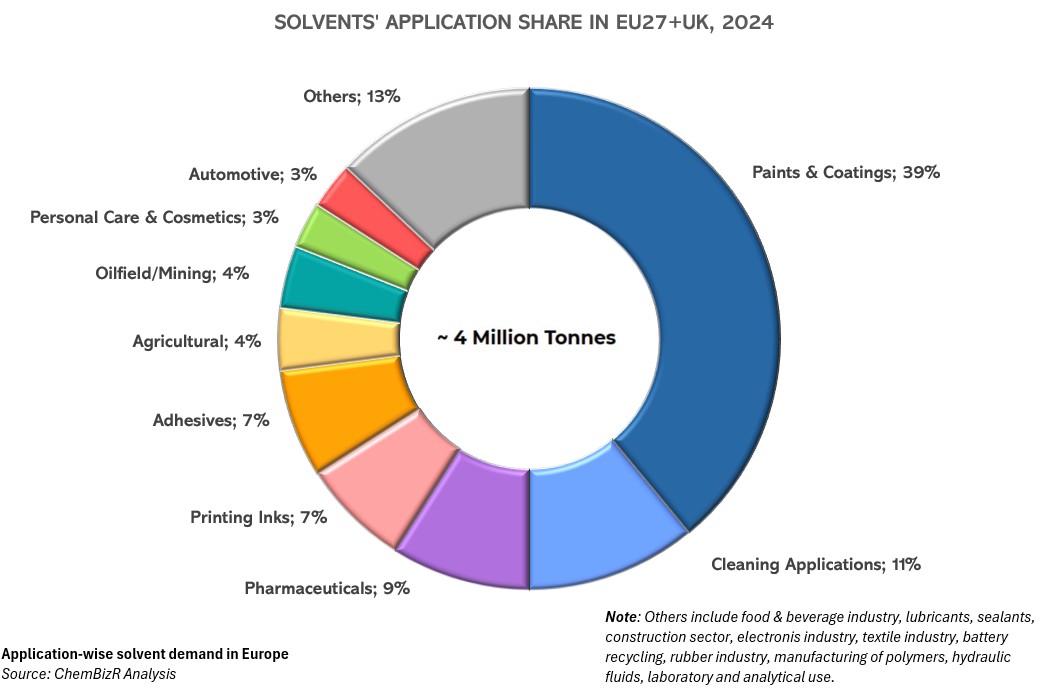
Solvents play essential roles across a wide range of sectors, from construction and consumer products to high tech industries. In construction and industrial manufacturing, around 6,500 paint and coatings companies and 150 printing ink producers rely on solvents to ensure that products spread smoothly, dry quickly, and deliver clean, high quality print results. Adhesive manufacturers—about 800 companies—also depend on solvents, as does industrial cleaning, which would be difficult to carry out effectively without them.
In consumer goods, healthcare, and personal care, solvents are equally indispensable. The pharmaceutical industry, with roughly 9,000 companies, uses solvents to extract, purify, or dissolve active ingredients. In cosmetics and personal care, involving around 10,000 companies, solvents transport fragrances and care ingredients; perfumes and disinfectants, for example, are almost always alcohol based.
Agriculture and food processing also rely on solvents. Approximately 1,200 companies in these sectors use them to produce flavours, plant extracts, oils, and crop protection products, and even packaging printing frequently involves solvent based processes.
In electronics and high tech manufacturing, solvents are vital for microchips, printed circuit boards, specialized cleaning, and various precision production steps—an area that continues to grow, even though it is not separately counted in industry statistics.
Energy and raw materials processing also depend heavily on solvents. In oil and mining applications—spanning roughly 17,000 companies—as well as in modern technologies like solar cells, wind turbines, and battery recycling, solvents play a key role.
The mobility and transport sector uses solvents in automotive coatings, brake fluids, and even aircraft de icing. Although the number of specialized automotive manufacturers is relatively small—around 50—solvents are critical to safety and performance in this field.
Finally, the chemical industry and numerous specialty applications include another 20,000 companies that use solvents as reaction media, cleaning agents, extraction materials, or formulation components—ranging from specialty chemical producers to recycling operations.
Solvents are not a niche topic—they are fundamental building blocks of modern value creation. From medicines to microchips, from paints to wind turbines: without solvents, many of the products that shape our daily life, and our future technologies simply would not exist.
Substances Can Do Much More Than Just Dissolve
“Solvent” is not a fixed family of chemicals but a function. Many substances that act as solvents in one application perform entirely different roles in others.
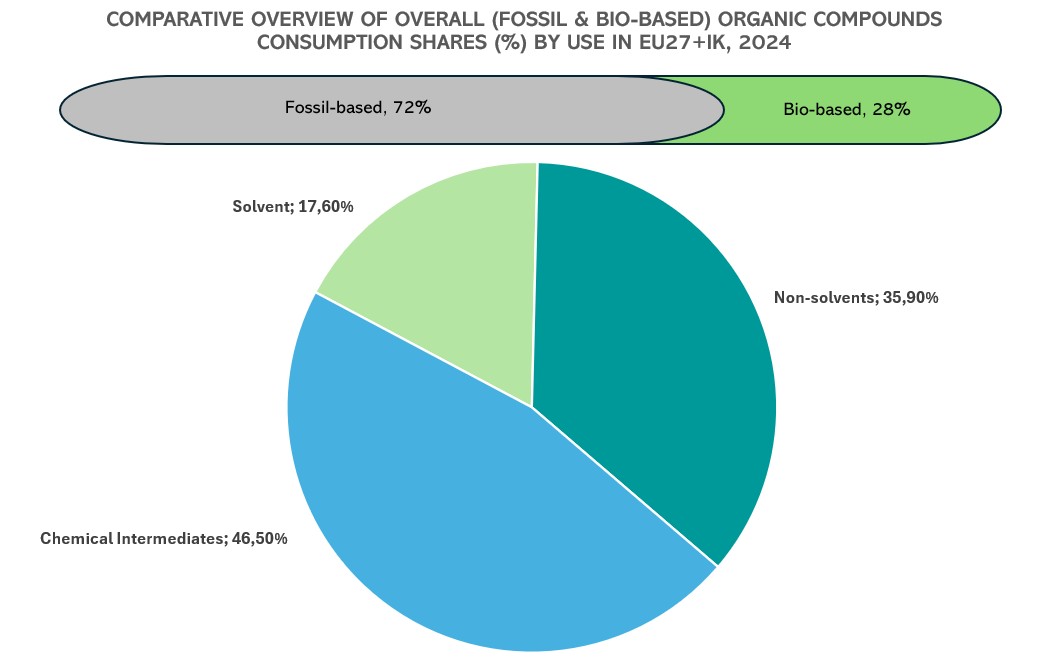
The role of a “solvent” is only one of many functions a substance can have. Ethanol is a good example of how a single chemical can perform quite different tasks depending on the application. It dissolves fragrance components in perfumes, making it function as a solvent, but in disinfectants it acts as the active ingredient responsible for killing germs. In beverages, ethanol serves as a carrier for flavours, while in chemical manufacturing it is an important feedstock for products such as ethyl acetate or glycols. It can even serve as an energy source in the form of bio-ethanol.
Myths & Facts on Solvents
Myth 1: “Green” solvents are automatically safe
In reality, safety depends on the chemical structure, not the origin. Biobased solvents can also be irritating, allergenic, or flammable.
Myth 2: “Solvent-free” means 0% solvent
In practice, small functional amounts are often needed for processing, drying, or stability. These tiny amounts act as helpers, not as active solvents.
Myth 3: Natural solvents are automatically better
Suitability always depends on the application—not the source of the material.
Myth 4: Solvents are always dangerous
Risk depends on the substance, the amount, the application, and the protective measures used.
“The dose makes the poison.”
Safe use comes from correct handling.
Solvents Key Applications

Construction
& Infrastructure
Discover more


Consumer Goods
& Household
Discover more


Electronics
& High-Tech
Discover more


Energy, Resources
& Industrial Facilities
Discover more


Health, Nutrition
& Life Sciences
Discover more

Mobility
& Transportation
Discover more

Chemical Industry
& Downstream Processing
Discover more


Emerging Technologies
& Niche Applications
Discover more