


Air Quality
ESIG at EU Clean Air Forum – 1 & 2 December 2025
The EU Clean Air Forum 2025 in Bonn made one point very clear: clean air is now equally a health, climate, and economic priority. The EU has made progress in recent years, but it will not meet its 2030 and 2050 targets without stronger implementation. Emissions from agriculture, wood and biomass heating, and transport remain particularly challenging.
New scientific findings highlight the close links between air pollution and cardiovascular disease, dementia, and child health. At the same time, Copernicus satellites and AI-supported modelling now enable far more precise air quality data and faster forecasting.
Key short-term levers for improvement include methane and black carbon, while wildfires are becoming an increasingly cross-border public health risk. Cities play a central role, for example, by expanding low and zero-emission zones, transitioning to clean heating systems, and strengthening public transport and active mobility.
The greatest risks identified were the implementation gap among Member States and the growing impact of disinformation. Still, investments in clean air are widely viewed as economically beneficial — but success will depend on consistent and socially fair implementation, especially in the areas of heating, transport, and agriculture.
UNECE – TFMM (Task Force Measurement & Modelling) – 28-29 April 2026
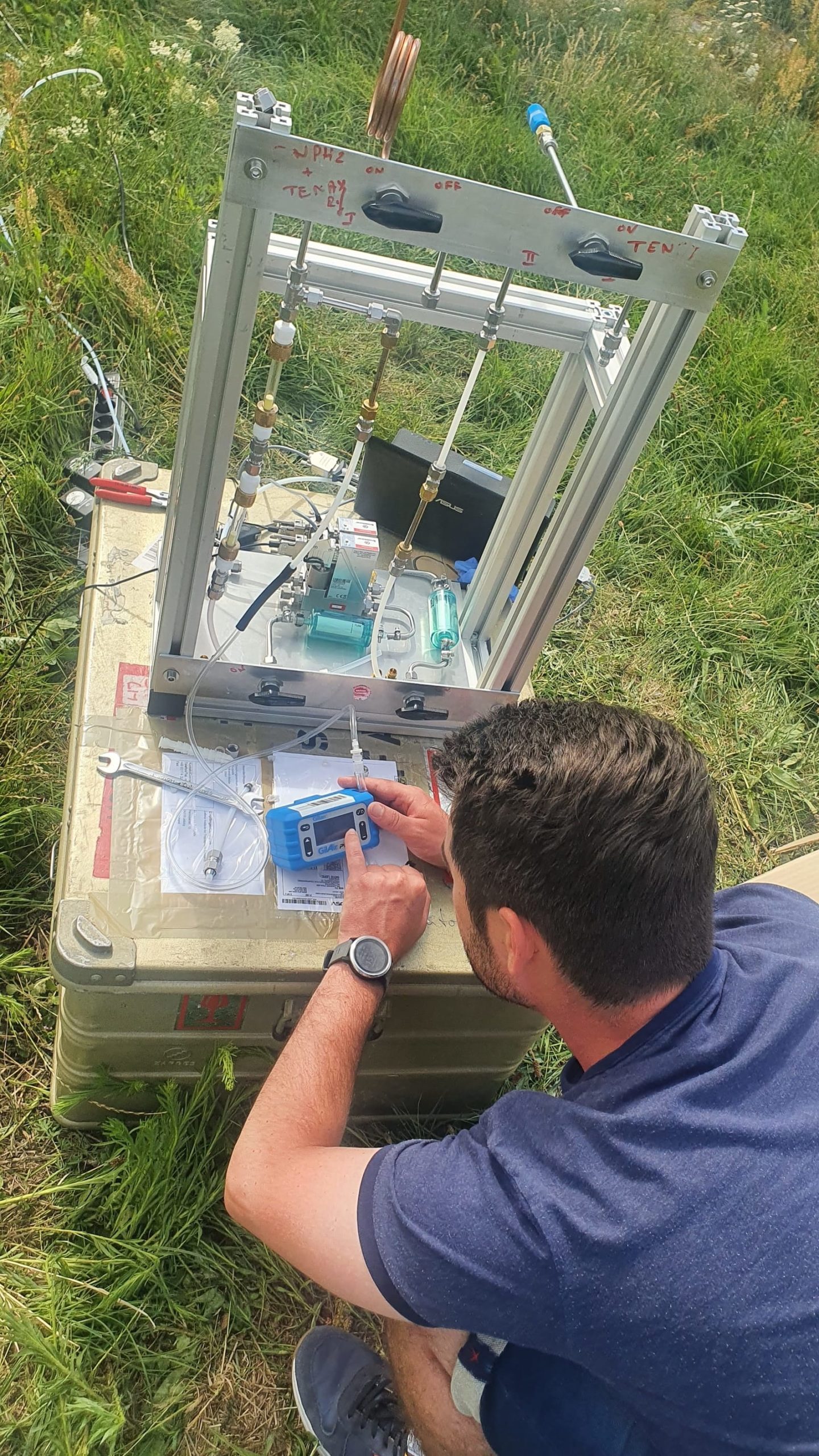
From 28th to 29th April 2026, experts from across Europe met at the 27th EMEP Task Force on Measurements and Modelling (TFMM) Meeting to discuss how measurements and models can be combined to deliver reliable air quality assessments.
Discussions on ozone formation highlighted a key point: it is not the emission amount that matters most, but the chemical reactivity of VOCs. Ozone peaks are mainly shaped by biogenic VOCs, while anthropogenic VOC sources remain relevant where they can be shown to contribute to ozone formation. Measurement data support this view: although substances such as ethanol and methanol dominate the VOC mass, highly reactive compounds play a decisive role in ozone peaks and secondary particulate matter formation – even at low concentrations.
Additional insights were provided by mobile measurement systems, which reveal short-term pollution peaks and local hotspots, for example in port, industrial or agricultural areas.
Beyond ozone, discussions also focused on particulate matter and ultrafine particles, as well as ammonia and nitrate as key drivers of secondary particulate matter formation. The influence of natural sources such as Saharan dust or wildfires was also highlighted.
Across all topics, a common message emerged: air quality is becoming increasingly complex. Robust, policy relevant assessments require the close integration of measurements, source apportionment and modelling.
UNECE – TFEIP (Task Force on Emission Inventories and Projections) – 11-13 May 2026
A second major strand was inventory systems and digitisation. Many countries still rely on complex Excel/Access setups, while others are moving towards scripted (R/Python) or platform-based solutions to improve QA/QC, traceability, version control and efficiency. Country case studies highlighted both the benefits and the practical challenges (complexity, usability, long-term maintenance).
For Solvents/NMVOC, the 2026 discussions made two points particularly clear:
-
- NMVOC needs more chemical detail for modelling: Beyond “NMVOC total”, there is growing attention to fractions such as IVOCs/SVOCs/OVOCs, because they matter for ozone formation and secondary organic aerosol (SOA).
- Solvent Use (NFR 2D) is primarily a data challenge: Emission factors can often be derived, but the biggest bottleneck remains reliable activity data. This drove calls for pragmatic “bridge” approaches (e.g., Tier 1.5/Tier 2) and targeted updates/corrections to NMVOC factors and methods.
Advancing NMVOC—especially in the solvent space—will depend not only on updated factors, but also on better activity data, stronger documentation and inventory workflows that can reliably carry updates into consistent time series.
New Release: VOC Emissions 2024 – A Record Year in Reverse
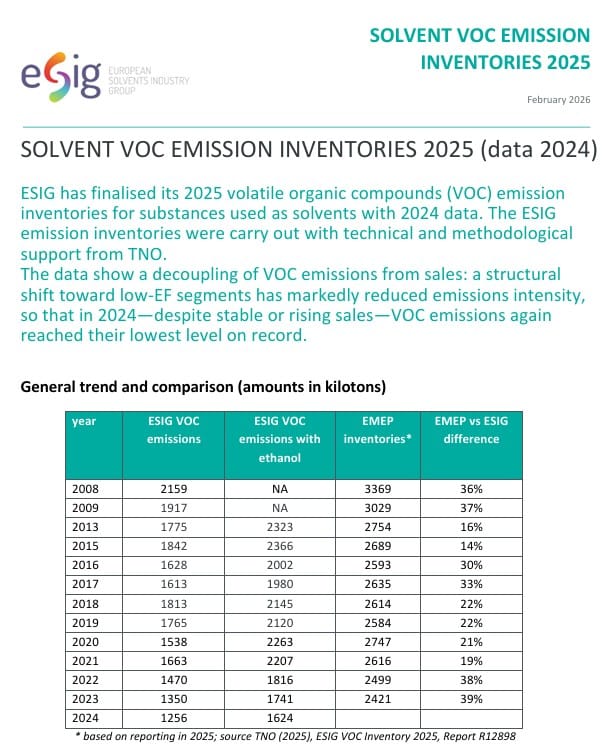
The new ESIG VOC Inventories 2025, developed together with TNO and based on the most up‑to‑date data through 2024, are now online. And the headline couldn’t be clearer: VOC emissions from solvent‑based applications fell again in 2024 – reaching the lowest level since records began.
Even more striking:
2024 marks the third consecutive record low – despite stable or slightly increasing sales volumes.
What is driving this decline?
-
- VOC emissions dropped by 7% compared to 2023 – both with and without ethanol. The downward trend continues.
- A structural market shift: High‑EF segments such as Coatings and Agrochemicals continue to shrink, while low‑EF (low Emission Factor) areas – e.g., Functional Solvents, Polymers Processing – keep growing.
- EF (Emission Factor) refers to how many VOC emissions are released per kilogram of solvent sold. High‑EF sectors emit far more VOC per tonne; low‑EF sectors emit significantly less.
- Ethanol, a major driver during the pandemic years, decreased by 6% in 2024.
Learn more
All details, clearly documented and transparently presented, can be found in our new ESIG Technical Paper “Solvent VOC Emission Inventories 2025 (Data 2024)” on our webiste